




Wendie Weldon
Fitness Trainer
NASM-CPT
Recently, there has been a shift toward longevity-focused fitness. With at-home Pilates, it’s not about noise or speed—no flashing lights or leaderboards—just you, your mat, and a deliberate return to control.
Mat Pilates, once overshadowed by reformer machines and boutique studio culture, is reclaiming its place. In 2026, more people are realizing that when you strip away equipment, momentum, and distraction, what’s left is the real work: stability, alignment, and awareness.
A Brief History of Pilates
To understand why Pilates resonates so strongly today, it helps to look back at its origins. The method was developed in the early 20th century by Joseph Pilates, a German physical trainer who believed that mental and physical health were deeply interconnected. During World War I, he began refining his techniques while working with injured soldiers, focusing on rehabilitation through controlled movement and breath.
Later, Pilates brought his method to New York City, where it gained popularity among dancers. They were drawn to its ability to build strength without bulk, improve flexibility, and prevent injury. For decades, Pilates remained somewhat niche, associated with elite performers and boutique studios. But over time, its principles began to spread into mainstream fitness.
Fast forward to 2026, and Pilates has undergone a cultural transformation. It’s no longer reserved for professionals; it’s embraced by people of all ages and fitness levels. The essence, however, remains unchanged.
The Benefits of Pilates
Pilates has endured because its benefits extend beyond aesthetics. Research over the past two decades has consistently supported its role in improving both physical and functional health.
1. Core Strength and Lumbar Stability
Studies show that Pilates effectively activates deep stabilizing muscles such as the transverse abdominis and multifidus, which are critical for spinal support and injury prevention (1). This translates into better posture, reduced lower back pain, and improved functional movement.
2. Improved Posture and Alignment
Pilates-based interventions have been shown to improve postural alignment, particularly in individuals with sedentary lifestyles (2). This is especially relevant in an era dominated by prolonged sitting and screen use.
3. Flexibility Without Compromising Strength
Unlike static stretching alone, Pilates enhances dynamic flexibility, improving range of motion while maintaining muscular control (3).
4. Balance and Neuromuscular Coordination
Research indicates that Pilates training can improve proprioception and balance, reducing fall risk and enhancing athletic performance (4).
5. Mental Health and Stress Reduction
The emphasis on breath and concentration has been linked to reductions in stress and improvements in overall well-being (5). Pilates functions as both a physical and cognitive practice.
What to Keep in Mind When Doing Pilates at Home (Evidence-Based Guidance)
Practicing Pilates without an instructor introduces a significant variable: self-correction. While this independence is empowering, it also increases the risk of reinforcing poor movement patterns. Research in biomechanics and motor control highlights several key considerations:
1. Neutral Spine Is Not Optional
Maintaining a neutral spine is fundamental to Pilates and spinal health. Studies show that deviations, particularly excessive lumbar flexion or extension, can increase compressive forces on the spine (6).
At home, many people unintentionally flatten or overarch their lower back, especially during core exercises. The goal is not rigidity but controlled alignment. A neutral spine allows for optimal load distribution and muscle activation.
2. Core Engagement Must Be Deep, Not Superficial
A common mistake is over-recruiting superficial muscles like the rectus abdominis (“six-pack” muscles) while neglecting deeper stabilizers. Research emphasizes the importance of activating the transverse abdominis for spinal stability (7).
Without proper engagement, movements may appear correct but lack functional benefit and may even contribute to strain.
3. Breathing Patterns Directly Affect Muscle Activation
Pilates breathing is not just stylistic, it’s functional. Studies show that coordinated breathing enhances core muscle recruitment and reduces unnecessary tension (8).
Holding your breath or breathing shallowly can disrupt movement patterns and increase fatigue. Exhalation during exertion helps facilitate core engagement.
4. Movement Quality Declines With Fatigue
Unlike some higher intensity workouts, Pilates relies on precision. Research in motor learning suggests that fatigue can compromise movement accuracy and reinforce incorrect patterns (9).
This means that doing fewer repetitions with proper form is more effective than pushing through quickly with poor control.
5. Visual Feedback Improves Technique
Without an instructor, external feedback becomes crucial. Studies show that visual input, such as mirrors or video recordings, can significantly improve movement accuracy and body awareness (10).
Practicing in front of a mirror or occasionally filming yourself can help identify misalignments you may not feel.
6. Progression Should Be Gradual and Structured
Jumping into advanced exercises without mastering foundational movements increases injury risk. Research in exercise progression emphasizes building stability before complexity (11).
For example, mastering a basic pelvic tilt and core engagement is essential before attempting roll-ups or leg extensions.
7. Neck and Shoulder Compensation Is Common and Problematic
Many individuals compensate for weak core muscles by overusing the neck and shoulders, particularly during exercises like the Hundred. This can lead to strain and discomfort.
Electromyographic studies show that proper technique minimizes unnecessary activation of these areas (12). If you feel tension in your neck, it’s often a sign to modify the movement.
20-Minute Mat Pilates Home Workout
Now, here’s a routine that puts this all together. This workout emphasizes control, alignment, and breath. Move slowly, focus on form, and rest briefly if needed. Optional equipment includes a Pilates ring, ankle weights, sliders, and an exercise ball, but everything can be done without them.
Check out our favorite Sunny Health and Fitness Pilates equipment:
-
Premium Exercise Ball
-
Extra Thick Yoga Mat
-
Anti-Slip Yoga Mat
-
15” Pilates Ring
-
Dual-Sided Exercise Disk
-
Wrist Weights
Warm-Up (3 minutes)
Pelvic Tilts (1 minute)

- Lie on your back with knees bent and feet flat on the floor, hip-width apart. Arms rest by your sides.
- Inhale to prepare. As you exhale, gently tilt your pelvis so your lower back presses into the mat.
- Inhale and return to a neutral spine (a small natural arch under your lower back).
- Continue slowly, focusing on controlled movement.
Purpose: Activates deep core muscles and brings awareness to spinal positioning.
Arm Raises with Breath Coordination (1 minute)

- Stay lying on your back with knees bent. Extend your arms toward the ceiling.
- Inhale as you slowly lower your arms overhead toward the floor (only as far as you can without arching your back).
- Exhale as you bring your arms back up to the starting position.
- Keep your ribs from flaring and your core gently engaged.
Purpose: Connects breath with movement and stabilizes the core.
Supine Spinal Rotation (1 minute)

- Arms extend out to the sides like a “T,” knees bent and together.
- Inhale. As you exhale, slowly lower both knees to one side, keeping shoulders grounded.
- Inhale to bring knees back to center, then repeat on the other side.
- Move within a comfortable range.
Purpose: Warms up the spine and improves mobility.
Core Activation (5 minutes)
The Hundred (2 minutes)

- Lie on your back. Lift your head, neck, and shoulders slightly off the mat.
- Extend your legs to a tabletop position (knees bent at 90°) or straight at a 45° angle (more advanced).
- Extend arms by your sides, hovering off the mat.
- Begin pumping your arms up and down a few inches while breathing: inhale for 5 counts, exhale for 5 counts.
- Continue until you reach 100 arm pumps.
Modification: Keep your head down or feet on the floor if needed.
Purpose: Builds endurance in the core and coordinates breath.
Single-Leg Stretch (1.5 minutes)

- Stay lifted through your head and shoulders. Bring one knee into your chest while the other leg extends out at a 45° angle.
- Place one hand on your shin and the other on your ankle.
- Switch legs in a controlled, alternating motion.
- Keep your core engaged and lower back stable against the mat.
Purpose: Strengthens the core while improving coordination.
Double-Leg Stretch (1.5 minutes)

- Start curled up with both knees pulled into your chest, hands resting on your shins.
- Inhale as you extend both arms overhead and legs out simultaneously.
- Exhale as you circle your arms around and hug your knees back in.
- Move slowly and avoid arching your lower back.
Purpose: Challenges full-core control and coordination.
Lower Body (5 minutes)
Glute Bridges (2 minutes)

- Lie on your back with knees bent and feet flat, close to your hips.
- Press through your heels and lift your hips off the mat until your body forms a straight line from shoulders to knees.
- Squeeze your glutes at the top, then slowly lower back down.
- Keep your ribs down and avoid over-arching your back.
Optional: Add ankle weights or place a small ball between your knees for added engagement.
Purpose: Strengthens glutes and supports lower back stability.
Leg Circles (1.5 minutes each side)

- Extend one leg straight on the mat. Lift the other leg toward the ceiling.
- Keep your hips stable as you draw small circles in the air with the lifted leg.
- Circle 5–8 times in one direction, then reverse.
- Keep movements controlled. Your pelvis should not rock side to side.
Modification: Bend the bottom leg for more stability.
Purpose: Improves hip mobility and core stability.
Upper Body & Stability (4 minutes)
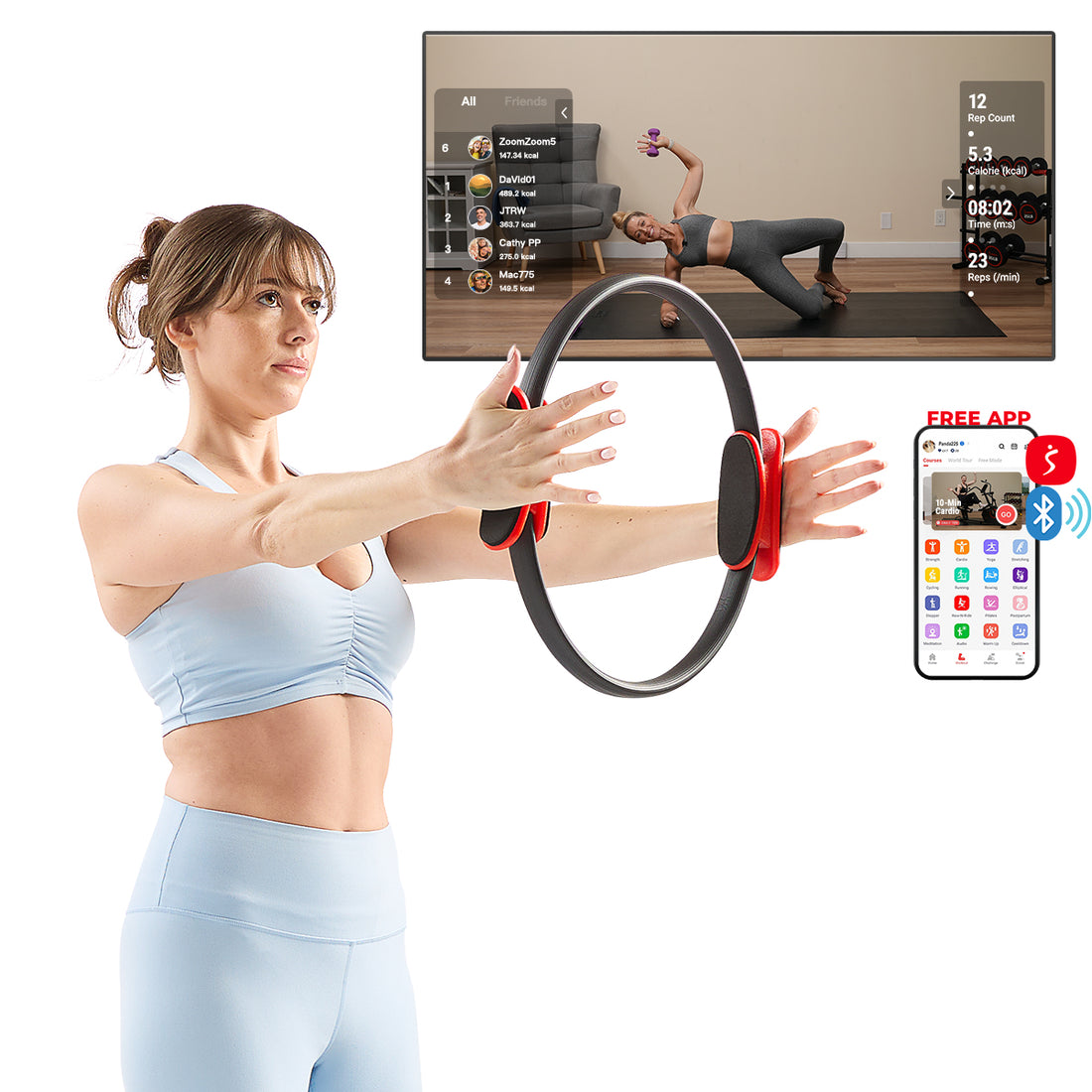
Chest Press with Pilates Ring (2 minutes)

- Lie on your back or sit upright. Hold the Pilates ring between your hands at chest height.
- Inhale. As you exhale, press inward on the ring while extending your arms forward.
- Inhale to return to the starting position.
- Keep shoulders relaxed and away from your ears.
Alternative: Use light weights or press palms together if no ring is available.
Purpose: Strengthens chest, arms, and stabilizing muscles.
Plank Hold (2 minutes)

- Start on your hands and knees, then step your feet back into a high plank position.
- Hands are under shoulders, body in a straight line from head to heels.
- Engage your core, glutes, and legs. Avoid letting your hips sag or lift too high.
- Hold while breathing steadily.
Modification: Drop to your knees if needed.
Purpose: Builds full-body strength and core stability.
Full-Body Integration (2 minutes)
Slow Mountain Climbers with Sliders (1 minute)

- Start in a plank position with sliders (or socks) under your feet.
- Slowly draw one knee toward your chest, then slide it back.
- Alternate legs in a controlled, steady rhythm.
- Keep hips stable and core engaged. Avoid bouncing.
Purpose: Integrates core, shoulders, and lower body.
Roll-Ups (1 minute)

- Lie flat with legs extended and arms overhead.
- Inhale to prepare. As you exhale, slowly roll your spine up one vertebra at a time, reaching toward your toes.
- Inhale at the top, then exhale as you slowly roll back down with control.
- Avoid using momentum. Move slowly and deliberately.
Modification: Bend knees or hold behind thighs.
Purpose: Improves spinal mobility and deep core strength.
Cool Down (1 minute)
Forward Fold and Controlled Breathing

- Sit tall with legs extended or crossed.
- Inhale to lengthen your spine, then exhale as you gently fold forward.
- Let your head and neck relax.
- Take slow, deep breaths, inhaling through your nose, exhaling through your mouth.
Purpose: Releases tension and resets your breathing.
This routine is most effective when done with intention. If something feels rushed, it probably is, so slow it down. Pilates works best when you treat each movement as something to practice, not just complete.
Stay Consistent
Struggling to stay consistent with Pilates at home? The SunnyFit App gives you step-by-step guided sessions, progress tracking, and trainer-led programs so you can build strength, improve posture, and stay motivated.


Add Your Name & Email
Please enter your name and email to continue.We won’t display your email publicly.