




Wendie Weldon
Fitness Trainer
NASM-CPT
If you've been eyeing a reformer but can't quite tell whether it's a serious strength tool or a glorified stretching machine, you're asking the right question. The honest answer is that it depends entirely on how it's used, and once you understand how reformer training actually applies resistance, the case for it as a legitimate strength-building tool becomes much stronger.
The mechanism behind that case is progressive resistance training: the same principle that drives barbell programming, translated into a system of springs, carriage tension, and body positioning. Understanding how progressive training operates on a reformer, and how it compares to barbells, machines, and bands, is the difference between using the equipment and actually training on it.
A Brief History
The reformer traces back to World War I, when Joseph Pilates, interned on England's Isle of Man, rigged springs to hospital beds to help injured internees rebuild strength before they could bear weight on their feet. That improvised setup evolved into the Universal Reformer: a sliding carriage connected to adjustable springs that resists movement in both directions.
Pilates later brought the system to New York, where it became the foundation of his broader "Contrology" method focused on precision, breath control, and resistance. He built his method into a single piece of equipment decades before "resistance training" was a mainstream fitness term.
Progressive Resistance Training: The Underlying Science
Progressive resistance was developed by U.S. Army physician Thomas DeLorme as a rehabilitation protocol for injured servicemen built around lifting near-maximal loads for multiple sets, then increasing that load as strength improved [1]. His method of three progressively heavier sets of ten repetitions, laid the groundwork for what exercise science now calls progressive overload: the systematic increase in demand placed on a muscle over time so the body keeps adapting.
That principle still anchors current guidelines. A 2026 American College of Sports Medicine position stand, synthesizing 137 systematic reviews covering more than 30,000 participants, confirmed that resistance training reliably improves strength, hypertrophy, power, and physical function compared with no exercise. The review found that strength gains are specifically enhanced by training with heavier loads (at or above roughly 80% of one-repetition maximum), through a full range of motion, for two to three sets, performed at least twice weekly. Continued long-term progress generally requires some form of increasing stimulus, whether through added load, volume, or frequency [2].
On a reformer, that progression happens through the spring system rather than iron plates. Resistance is increased by adding springs, adjusting carriage tension, shortening the effective lever length, or changing one’s body position to shift more load onto the working muscle. The mechanism looks different from a barbell, but it's driven by the same physiological logic DeLorme described eighty years ago: give the muscle a reason to keep adapting.
Is Reformer Pilates Different from Other Resistance Training?
Mechanically, yes, and the difference has real training implications. Traditional resistance training, whether free weights or machines, relies largely on gravity and typically loads a muscle unevenly across a joint's range of motion. A reformer's springs create resistance throughout the entire movement, including the return phase, which keeps muscles under more continuous tension than a standard concentric-eccentric lift against gravity alone.
Ina 16-week study, researchers compared older women (ages 65-85) doing PNF-supported reformer Pilates (spring-mediated support and resistance) against the group doing Hatha Yoga (with no external loading), testing different kinds of strength: trunk stability, dynamic balance, and muscular endurance. Researchers found that while both groups improved on functional and cognitive performance, Pilates-based training showed greater improvements on the aforementioned areas, spinal mobility and joint mobility. Pilates can be a tool that builds a different kind of strength [3].
Reformer Pilates layers core stabilization, spinal alignment, and controlled eccentric movement onto a resistance stimulus in a way barbell training generally doesn't emphasize.
Benefits of Reformer Resistance Training
The evidence base, while still growing, points to several consistent benefits:
-
Functional strength and endurance gains. Reformer Pilates builds real, measurable strength, not just flexibility. Regular training improves upper body strength along with muscular endurance in the trunk, back, and core, meaning muscles can work longer before fatiguing [4].
-
Body composition changes. Adding resistance to your workout can shift body composition in a favorable direction. Consistent training is linked to lower body fat percentage alongside increases in muscle mass, suggesting it does more than just tone. It can build muscle while reducing fat [4].
-
Lower-extremity strength. Although this exercise emphasizes the core, it can also help strengthen the legs. It improves lower-body strength enough to be measured on standard functional tests, like how easily someone can stand up from a seated position, a marker often used to track strength and mobility in clinical settings [5].
-
Core and postural stability. The controlled movement used in reformer Pilates is especially effective for core stability. Because the body must stabilize against a moving carriage throughout nearly every exercise, it strengthens the deep muscles that support posture and spinal alignment, muscles that are harder to target with standing weightlifting [6].
-
Trunk strength and balance in older adults. This exercise holds up well as a strength option for older adults. It produces trunk strength and balance improvements, making it a low-impact exercise for people who want strength gains with controlled, resistance-based movements instead of heavy loading. [3].
-
Psychological benefits. Aside from physical strength, reformer Pilates supports mental health. Regular training is linked to reduced symptoms of depression and anxiety, adding a mood benefit on top of the physical gains [4].
Resistance Training Exercises and Poses
What does strength-focused reformer Pilates look like in practice? The key is progression. Use the spring tension, controlled repetition, and increasingly challenging movements to place a great demand on muscles.
Reformer sessions typically progress through recognizable phases, mirroring the load-and-repetition progression central to strength training. A well-structured routine also tends to move from bilateral, foundational movements toward single-limb and more complex full-body work as strength and control improve. Here are some exercises you can try:
Beginner-foundational
-
Footwork — performed lying on the carriage, pressing through a footbar against spring resistance. This warms up the lower body while establishing carriage control.

-
The Hundred — a classic core-activation exercise combining pulsing arm movements and coordinated breathing with sustained abdominal engagement against the carriage's resistance.

-
Rowing series — seated exercises using long straps that mimic pulling movements, targeting the back and shoulder stabilizers.
-
Leg and side-lying series — resistance-based hip and thigh work performed against spring tension, often progressed by reducing spring support to increase demand.
Intermediate
-
Elephant — a standing hip-hinge performed on the carriage, building hamstring and calf strength while reinforcing control on both the push and return phase of the movement.
-
Short box series — seated on the box facing the footbar, working spinal flexion, extension, and rotation against strap resistance. A useful reminder that core training isn't limited to abdominal crunching.
-
Mermaid — a seated side-bend and rotation using a single strap, adding lateral flexion and rotational strength that the more linear exercises above don't address.
-
Long stretch and plank-based work — full-body integration exercises where the practitioner's own body weight combines with spring resistance to challenge shoulder and core stability simultaneously.
Advanced
-
Splits series (front and side) — standing or kneeling on the carriage with one leg fixed and one leg driving the carriage, building single-leg strength and balance after the bilateral groundwork above has been established.


-
Teaser — a full-body core exercise combining spinal flexion with hip flexor and abdominal control, typically introduced once foundational core and hip strength are established.
Breath and form
Reformer Pilates also differs from typical gym training in how closely breath is tied to movement. Exercises generally follow an exhale-on-exertion pattern — breathing out during the most demanding phase of a movement — which is used to support core engagement and control rather than just oxygen delivery. This is one of the more distinctive features of the method compared with a standard strength circuit, where breathing cues are usually secondary.
A common mistake
Spring resistance can be deceptive for beginners. Because the carriage assists with the return phase of a movement, it's easy to underestimate how light a spring setting is and progress too slowly out of caution. This is the opposite of the more familiar risk in free-weight training, where the more common mistake is loading too much weight too soon. On a reformer, going too light for too long is the more frequent obstacle to real progress.
As with any progressive resistance program, the specific exercises matter less than the underlying structure: consistent exposure, a clear method for increasing demand over time, and enough recovery between sessions to allow adaptation.
Choosing a Reformer for Home Use
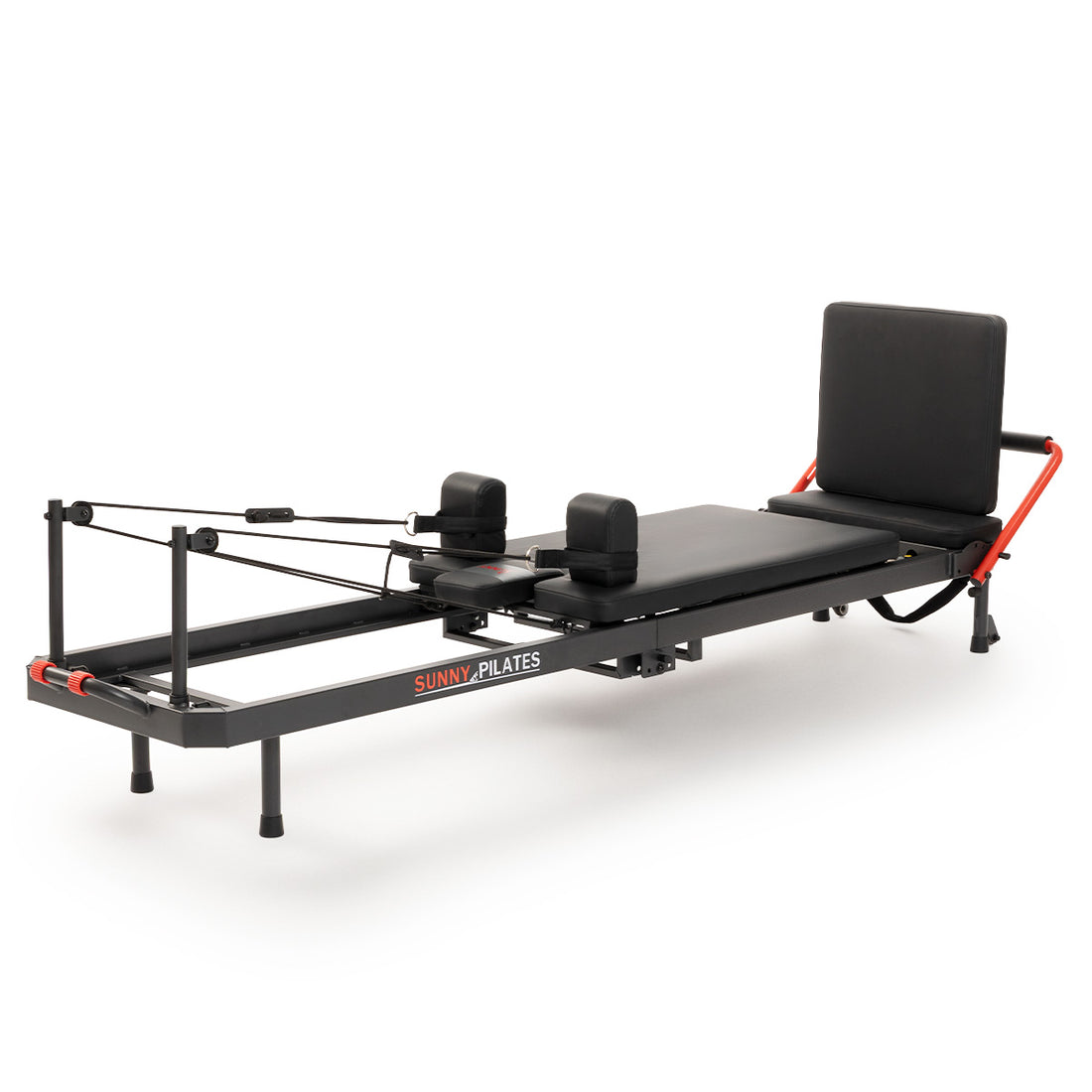
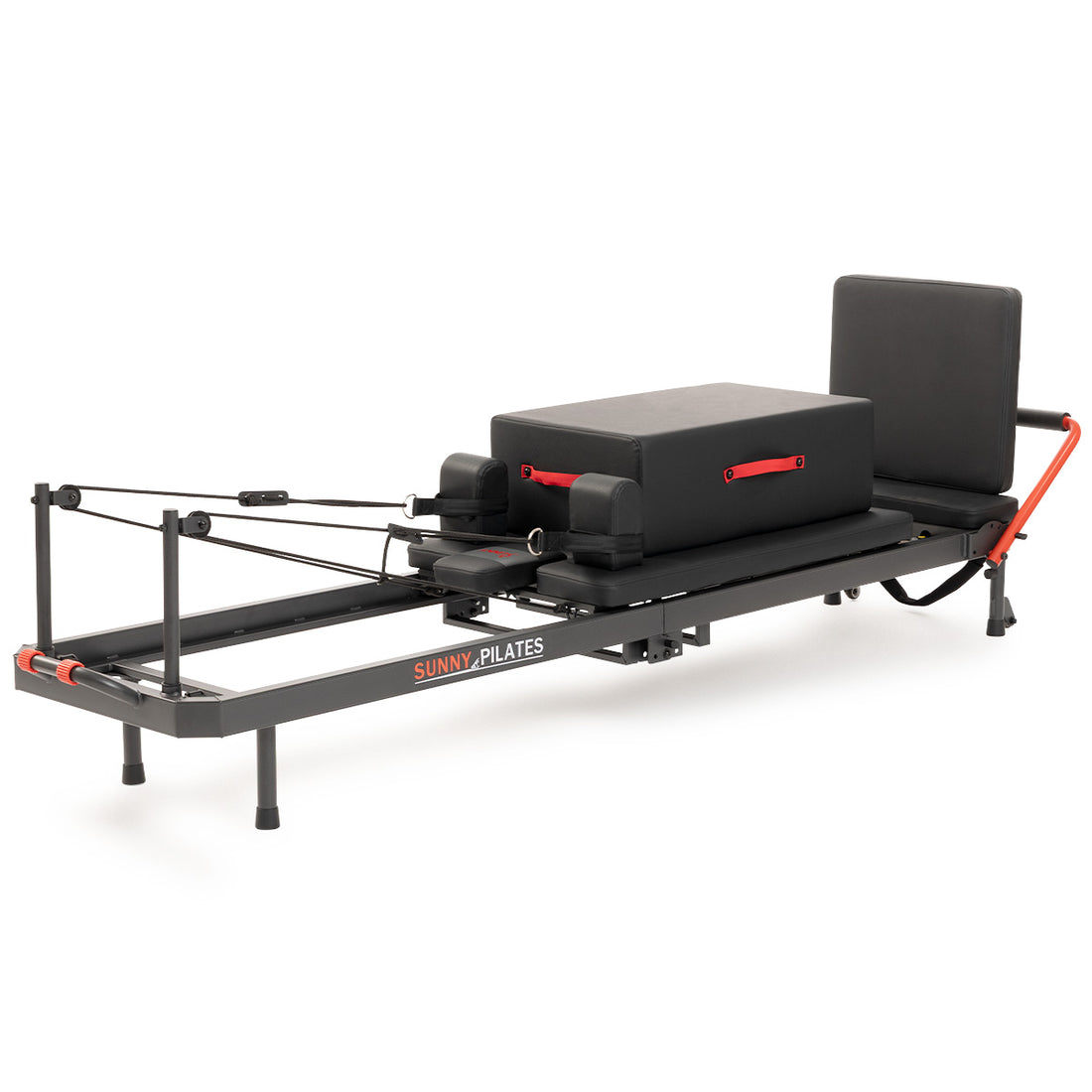
For anyone considering bringing a reformer into their own home, the same progressive-loading principle discussed earlier is the first thing to look for in the equipment itself. Your equipment should give you room to increase the challenge over time. That means, you're looking for a combination of adjustable resistance, smooth movement, and set that makes progressive training practical. Sunny Health & Fitness's home reformer line, the SF-PM10 and its upgraded counterpart, the SF-PM20, might be the best option for you.
Spring system. Both models use five color-coded resistance springs — two 10 lb (yellow), two 15 lb (blue), and one 28 lb (red) — that can be combined in different configurations to scale resistance up as strength improves. That range, from roughly 10 lb to a combined maximum well over 60 lb, gives a home user meaningful room to progress over months of training rather than plateauing within a few weeks.
Adjustability. A 5-position footbar, 3-position headrest, and 3-height pulley risers let the machine adapt to different body proportions and exercise variations, which matters for maintaining the alignment-focused form Pilates depends on. An easy-adjust rope system and double-loop straps also make it faster to switch between exercises without stopping to rethread equipment.
Build and glide quality. Search for a reformer Pilates that features durable steel frame, a smooth-gliding carriage, a premium padded carriage platform, and quiet TPR (thermoplastic rubber) rollers — details that affect both workout comfort and how consistent the resistance feels rep to rep.
Practical footprint. Because both models fold and include four transport wheels, they're designed to be stored upright between sessions rather than requiring a dedicated room, which is often the deciding factor for home buyers with limited space.
Capacity and fit. Each reformer supports users up to 300 lb and accommodates heights up to 6 ft. 3 in., which covers the majority of home users without needing a specialty frame.
Choosing between the two models. The SF-PM10 and SF-PM20 share the same core specs; the SF-PM20 adds a reformer box, an accessory used for seated and kneeling exercises that expand the range of movements possible on the machine. For someone who anticipates wanting more exercise variety as their practice develops, that add-on is worth factoring into the decision up front, since it extends the "progression" available on the machine itself, not just the springs.
The Bottom Line
While reformer Pilates can look different from strength training, the combination of spring resistance, controlled movement, and progressive overload can challenge the muscles and support improvement in strength, endurance, balance, and core stability.


Add Your Name & Email
Please enter your name and email to continue.We won’t display your email publicly.