




Denise Cervantes
Fitness Trainer
ACSM-CPT, AFAA-CGFI
Who knew that what originated as grain measuring tool would become one of the most popular functional training tools for athletes. Kettlebells originated in Russia more than 300 years ago and have become a favorite fitness equipment selection since the 20th century (Pavel Tsatsouline, 2017, McGraw, 2013).
Kettlebell training has experienced a surge in popularity largely due to its versatility, efficiency, and emphasis on functional fitness (Pavel Tsatsouline, 2001).
Incorporating kettlebell training in your current workout routine can enhance functional strength development, cardiovascular conditioning, and mobility improvement.
Read on to learn all the benefits of adding the kettlebell to your training routine and learn different exercises you can start trying today.
Top 5 Science-Backed Benefits of Kettlebell Training
Kettlebell training stands out for its ability to develop functional strength, improve cardiovascular fitness, enhance flexibility and promote core stability. Kettlebell workouts also lead to effective muscle activation and metabolic responses that support overall fitness goals.
Integrating kettlebell training into a fitness regimen can yield numerous benefits, making it a valuable tool for both general fitness enthusiasts and athletes alike.
Functionality
Kettlebell exercises are designed to mimic real-life movements, engaging multiple muscle groups simultaneously to enhance overall strength and coordination. This functional approach benefits not only athletes but anyone looking to improve daily activities, helping preventing injuries caused by poor movement patterns. The dynamic nature of kettlebell workouts makes them particularly appealing to those seeking to enhance their physical capabilities and move better in everyday life.
Efficiency
In today’s fast-paced world, individuals are increasingly seeking time-efficient fitness solutions. Kettlebells facilitate high-intensity workouts that seamlessly blend strength training with cardiovascular conditioning. This dual focus allows participants to achieve significant fitness gains in shorter time frames, making kettlebell sessions both effective and efficient.
Versatility
These weights can be utilized across a wide spectrum of exercises, from traditional strength training to mobility and flexibility workouts. This adaptability makes kettlebells suitable for various fitness levels, attracting a diverse audience ranging from beginners to seasoned athletes.
Mobility & Recovery
Integrating kettlebell movements that promote mobility and recovery has become increasingly important. These exercises help maintain flexibility and joint health, essential elements for longevity and injury prevention. Adding in kettlebell training can be an asset for those looking to maintain an active lifestyle over the long term.
Ease of Use
Unlike barbells, which often require a dedicated gym environment and specific equipment for safety, kettlebells can easily be used in small areas, making them ideal for home workouts. This ease of access has broadened the appeal of kettlebell training, attracting individuals who may have previously felt intimidated by traditional gym settings or those simply looking for efficient workout options that fit into their busy lives.
Kettlebells vs. Dumbbells vs. Barbells: Which Is Better?
Kettlebells offer a unique training stimulus that differentiates them from dumbbell and barbell exercises. While dumbbells and barbells are excellent for isolation exercises and controlled movements, kettlebells excel in dynamic, compound movements that require coordination and power due to their unique design that shifts the center of mass away from the hand.
The offset center of mass necessitates greater core engagement, enhancing stability and functional strength throughout various movements.
Movements such as the Turkish get-up or kettlebell windmill not only build strength but also enhance stability and coordination, crucial for maintaining functional movement patterns.
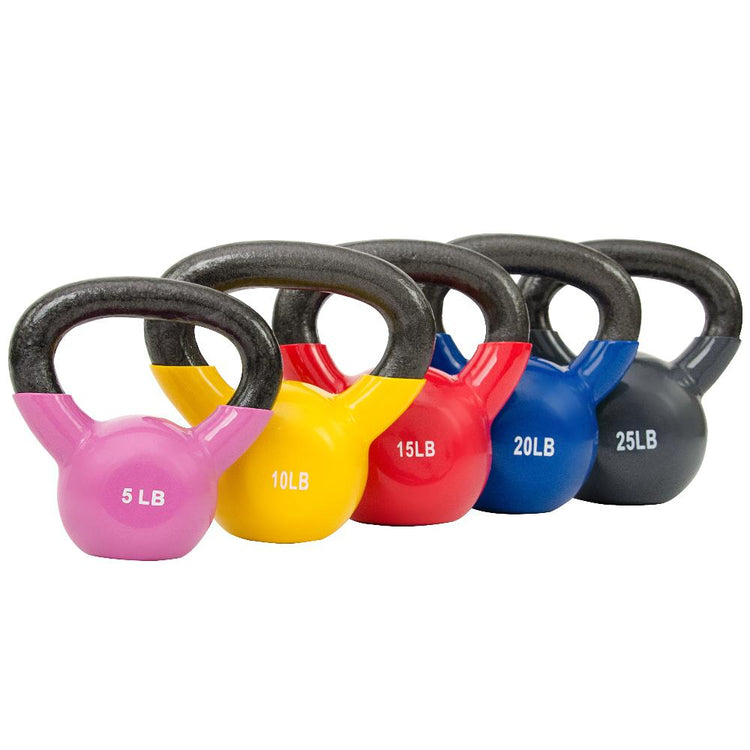
Kettlebell Guide: How to Add Kettlebells to Your Current Routine
4 Essential Kettlebell Exercises for Beginners
Kettlebell Swings
The kettlebell swing is a powerful hip hinge movement, not a squat or arm raise. It is designed to target the glutes, hamstrings, and core:

- Stand with feet shoulder-width apart.
- Hinge at the hips to grab the handle of the kettlebell.
- Hike it between your legs.
- Snap your hips forward to propel the bell to chest or shoulder height.
Goblet Squat
The kettlebell goblet squat is a fundamental movement that builds lower body strength and improves overall squat mechanics. By holding the weight in front of your chest, it acts as a counterbalance, making it easier to keep your torso upright and reach a deeper squat compared to traditional variations:

- Stand with your feet shoulder width apart and toes angled slightly outward.
- Hold the kettlebell by its horns close to your chest, keeping your elbows tucked in towards your ribs.
- On the way down, inhale and brace your core. Simultaneously push your hips back and bend your knees as if sitting into a chair. Keep your chest tall and your eyes facing straight ahead.
- Lower until your thighs are at least parallel to the floor. At the bottom, your elbows should ideally be positioned just inside your knees to help track them over your toes
- As you come up, drive through your whole foot to stand back up.
- Exhale as you raise and squeeze your glutes at the top without over-arching your back
Turkish Get-Up
The Turkish getup is a complex, multi-step movement that takes you from lying on your back to standing while keeping a kettlebell locked out overhead. It builds total body strength, core stability, and shoulder mobility. For safety, practice first with no weight or a light object before using a kettlebell.

- Start in the fetal position next to the kettlebell, grip with both hands, roll onto your back, and press it overhead with one arm locked out.
- Bend the same-side knee (bell side), place the foot flat, and extend the opposite arm and leg at a 45° angle.
- Roll onto your elbow, then post up onto your hand, keeping your eyes on the kettlebell.
- Lift your hips and sweep the straight leg back, placing the knee under your hip (half-kneeling position).
- Bring your torso upright and align into a lunge.
- Drive through both feet to stand tall, keeping the kettlebell locked out overhead. Reverse the movement: step back into a lunge, place your hand down, sweep the leg through, and return to the floor with control.
Kettlebell Deadlift
The kettlebell deadlift is a foundational hinge movement that prepares you for the kettlebell swing. It focuses on picking weight up from a dead stop using your glutes and hamstrings while keeping your spine protected:

- Stand directly over the kettlebell with your feet shoulder width apart, the handle in line with your ankle bones.
- Push your hips back in a hinge as if trying to touch a wall behind you with your glutes. Keep your chest up, chin lightly tucked, and slightly bend your knees, do not let them drop into a full squat.
- Reach down and grab the handle with both hands. Pull your shoulder blades back and down.
- When you lift the kettlebell, drive through your whole foot, keeping your weight centered and push the floor away.
- Stand tall until your hips are fully extended. Reach the lockout by squeezing your glutes at the top and do not lean back or hyper extend your spine.
- As you descend, reverse the movement by pushing your hips back first, guiding the kettlebell in a straight line back to the floor between your ankles.
7 Types of Kettlebell Grips
1. Two-Handed Grip: Both hands hold the handle or corners, commonly used in exercises like swings and deadlifts.
2. Single-Handed Grip: One hand holds the kettlebell handle, allowing for unilateral movements like snatches and overhead presses.

3. Goblet Hold: Holding the kettlebell by the body or the neck with both hands, this grip is often used in squats and lunges. You can also use the goblet hold with the kettlebell base up or upside down by the horns or bell in the goblet hold.

4. Front Rack Position: The kettlebell is held close to the body at shoulder height, used during exercises like presses, lunges, marching and squats for strength, functionality and stability.

5. Overhead Position: The kettlebell is lifted above the head, but the handle with wrists through the window of the kettlebell, engaging the shoulders and core, is often used in overhead presses and holds.

6. Bottoms Up: Often used in rehab strengthening for the wrists and shoulders. The person holds the kettlebell by the handle, with the base facing the sky, to train stability in the wrists and shoulders.

7. Farmer’s Carry or Suitcase Carry: Hold two kettlebells by the handles in each hand at your sides, or you can challenge yourself by using one kettlebell. It challenges the core as you walk a targeted distance with heavy kettlebells, using quick, strong strides while flexing the entire body to maintain an upright posture.

Best Beginner Kettlebell Workouts (Free Video Guides)
If you’re ready to start incorporating kettlebell workouts into your routine, but don’t know where to begin, the SunnyFit® app and Sunny Health & Fitness YouTube channel are great places to start. Start with these:
10 MIN BEGINNER KETTLEBELL - LOWER BODY | Sunny Strength®:
15 Minute Full Body Kettlebell Circuit | Full Body Workout:
10 Minute BEGINNER Kettlebell Workout for Sensitive Knees:
Total Body Kettlebell Workout - Strength Training Circuit | 20 Minutes:
15 Minute Weighted Kettlebell Core Finisher:
Start Your Kettlebell Journey with Sunny Health & Fitness
Kettlebell training offers a multitude of benefits that can significantly enhance your fitness journey and add a little fun. These versatile tools help improve strength, flexibility, and endurance, making them perfect for a full-body workout. The dynamic nature of kettlebell exercises engages multiple muscle groups simultaneously, promoting functional fitness that translates well to everyday activities. Moreover, kettlebell workouts can boost your cardiovascular health, improve core stability, and increase overall power, making them an excellent choice for anyone looking to elevate their fitness routine.
If you’ve been thinking about starting your fitness journey or shaking up your current routine, there’s no better time than now. So why wait? Dive into the world of fitness with us and discover the joy of working out in a community that truly cares. Let’s get moving!


Add Your Name & Email
Please enter your name and email to continue.We won’t display your email publicly.