




Sydney Bueckert
Fitness Trainer
CES, FNS, GPTS, NASM-CPT
If you’ve ever tried to do a pull-up, you don’t need us to tell you they’re one of the most challenging exercises to execute. They’re also one of the best indicators of functional upper body strength.
The road to your first pull-up usually isn’t easy. It may require some modifications and other exercises to build the strength needed for your first rep. But, the extra work and strength gained along the way make being able to do a pull-up that much sweeter.
Ready to master the art of the pull-up? All you need is the guide below and a pull-up bar.
Pull-Up Muscles Targeted
During a pull-up, there are a variety of upper body muscles worked. Pull-ups are primarily back and upper body focused, with an emphasis on the latissimus dorsi (lats), and heavy assistance from your biceps.
Other muscles worked include your infraspinatus (part of your shoulder cuff) which helps stabilize your shoulder joint as you elevate and depress your shoulders, and your lower trapezius (traps) will help to pull your shoulders back and down.
Finally, your core - specifically your erector spinae (lower back), abdominals, obliques, and even glutes - work together to help you maintain proper body positioning, posture, and stability during each rep.
How to Do a Pull-Up
Completing your first pull-up is a huge accomplishment. To perform a pull-up complete the following steps:
- Grip the bar with your hands shoulder-width apart and palms facing away from you. If you need help reaching the bar you can use a box or jump up to grab the bar.
- Hang with arms fully extended. You can bend your knees if your feet are dragging on the ground.
- Keep your shoulders back and core engaged as you engage your upper body to pull you up towards the bar, leading with your chest.
- Continue pulling upwards until your chin is above the bar, pause here.
- Slowly lower down to your starting position.
- Repeat. Try not to swing, kick, or use your momentum to help with your reps, each rep should be even and controlled.
If you’re not yet able to complete a pull-up - no biggie. There are tons of modifications, steps, tips, and tricks to help you get there. Keep reading.
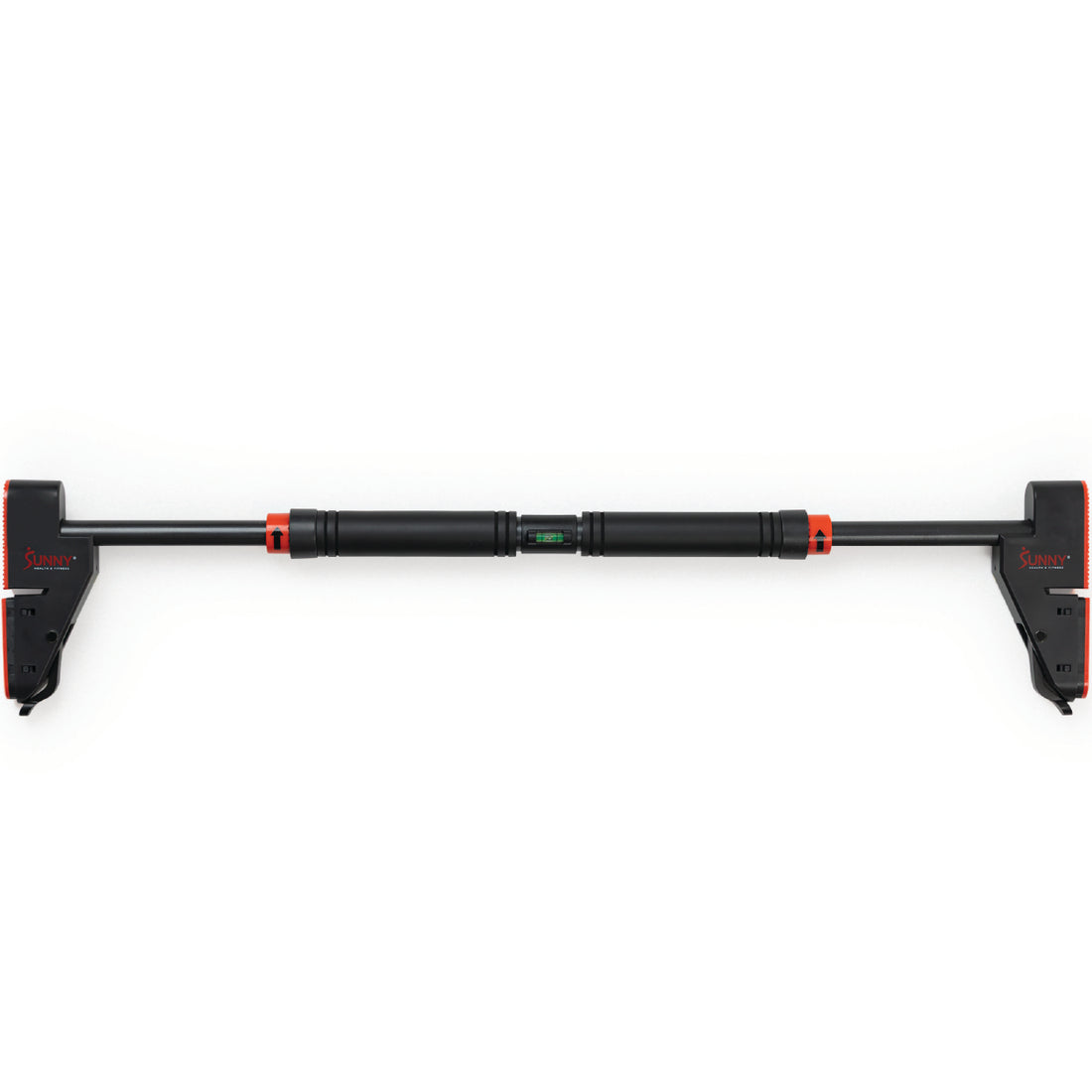
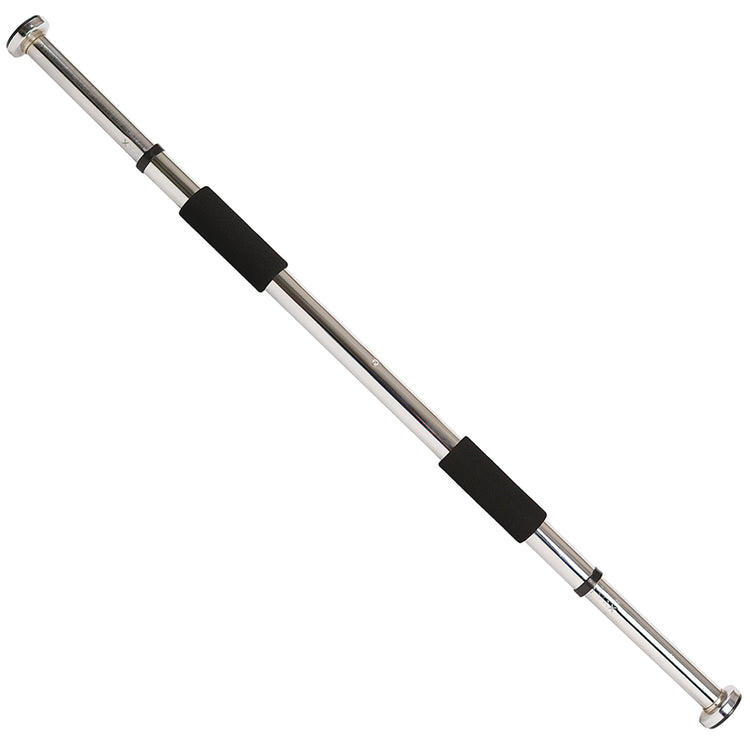
If you’re training at home, a secure doorway pull-up bar can help you practice dead hangs, assisted pull-ups, chin-ups, and hanging core exercises without needing a gym setup.
4 Exercises to Train for Your First Pull-Up
Use these exercise modifications to help you work up the strength for pull-ups. Or use them as supporting exercises in your routine to help you level up your pull-up game.
Either way, they’ll make a great addition to your workout routine.
1. Inverted Row
Inverted rows are more rhomboid, mid, and lower trapezius focused; whereas pull-ups are more lat focused. What inverted rows are good for is helping to strengthen all the muscles involved in scapular retraction which is an important element of your pull-up. During a pull-up you want to pull from your back, which is exactly what you’re practicing during inverted rows.
To perform an inverted row, complete the following steps:
- Grab the bar with hands facing out. Walk your feet forward so your body is at an incline.
- Hang from the bar with your body in a nice straight line from head to heels, core and glutes engaged, and chest proud.
- Drive your elbows down and back to row your chest up towards the bar. Focus on using both your back and arms to row and not just your arms, you should feel your back engage here.
- Pause at the top, slowly lower back down.
- Do not lose tension at the bottom, keep your core engaged and chest proud.
- Repeat.
Trainer Tip: You can make inverted rows easier by bending your knees and planting feet firmly on the ground. You can make them more challenging by extending your legs, flexing your feet, and supporting yourself with your heels while keeping your entire body straight and neutral as you row. The closer you are to parallel with the ground, the harder this exercise becomes.
2. Lat Pulldowns
Lat pulldowns closely replicate the range of motion and muscles used during a pull-up. With lat pulldowns, you’re directly strengthening the muscle that’s most engaged during a pull-up - your lats.
To perform lat pulldowns, complete the following steps:
- Using a lat pulldown machine, or cable machine for this exercise you can either kneel, sit on a bench, or stand to complete your reps depending on your setup.
- Grip the bar with your hands shoulder-width apart, palms facing forward, and arms extended fully overhead.
- Pull the bar to the top of your chest, imagining you’re squeezing a pencil in between your shoulder blades.
- Control the bar as you return to the starting position.
- Repeat.
Trainer tip: The wider your grip during your lat pulldown, the more you isolate your lats, but a standard or closer grip is also great for increasing upper body strength. Using a variety of grips in your training will help you make greater gains to your pull-up game.
3. Jump Pull-Up (or Pull-Up Hold)
Jump pull-ups can help you get to the top of each rep with ease. Once you get to the top you can focus on building your isometric strength at the upper range of your pull-up. As you jump up, focus on holding yourself at the top of your pull-up as long as you can.
To perform a jump pull-up, complete the following steps.
- Spring off the ground, grabbing the pull-up bar with palms facing away from you and muscling your way up to hold your chin above the bar.
- Hold here for as long as you can.
- Slowly lower until your arms are fully extended overhead, in a ‘dead hang’ position.
- Repeat.
Trainer Tip: The isometric hold is the focus of this move (not the jump). Keep in mind you can also use a bench to help get yourself into position for each rep. As you gain strength, challenge yourself by timing yourself at the top of each rep and pushing yourself to hold for longer than before. You can also make this variation harder by relying less and less on your jump to pull yourself up.
4. Eccentric Pull-Up
Eccentric pull-ups (or negative pull-ups) are great because they focus on controlling the lowering phase of the movement. Over time, building eccentric (lowering) strength will improve your ability to lift yourself without assistance as well.
To perform an eccentric, pull-up, complete the following steps:
- Spring off the ground, grabbing the pull-up bar with palms facing away from you and muscling your way up to hold your chin above the bar.
- Pause here for 3 seconds.
- Slowly lower yourself, taking about 6 seconds to lower until your arms are fully extended overhead, in a “dead hang” position.
- Repeat.
Trainer tip: Your focus during eccentric pull-ups should be on the lowering phase of your pull-up. So, if you’d like to use a bench or plyo box to get into position on the bar, this will work as well and maybe be a more comfortable place to start.
5 Pull-Up Form Tips
If you have completed your first pull-up, that’s only the beginning of your work. Your pull-up form is extremely important and translates directly to the quality of your reps, muscles worked, and strength gained over time.
Now it’s time to work on your form and build in volume so you can continue to increase strength. Below, I’ve listed some of the top things to keep on your mind during each rep and set.
1. Brace Your Core
While pull-ups are upper body focused, your core plays a big role. With a properly engaged core (including abs, lower back, and even glutes) your entire body will be focused on helping you complete each rep.
By engaging your core, you’ll also increase your control, reducing any swinging or momentum you may experience between each rep, and returning the focus into your arms and lats, exactly where we want it to be.
2. Complete a Full Range of Motion
Using a full range of motion will better recruit and engage all the muscles you’re looking to work. If you’re fine with cheating - well hey, we’re not stopping you. But don’t be upset if you miss out on some strength gains.
With each pull-up rep, start and end in a ‘dead hang’ position with arms fully extended overhead. Slowly lower from your pull-up at the end of each rep to reduce impact and increase strength.
3. Pause at the Top
Pause at the top to build more control with each rep you complete. Over time, that control will lead to greater strength and performance gains. Squeeze your muscles when you pause, to ensure your muscles are appropriately engaged and active before returning to your starting position.
4. Switch Up Your Grip
Switch your grip between wide, narrow, overhand, underhand, and neutral grip to recruit more muscles and correct any weaknesses you may have for greater overall pull-up strength. A variety of grips to establish a well-rounded pull-up routine and continue challenging yourself.
5. Modify if Needed
If you can’t complete a pull-up, don’t sweat it. There are many pull-up modifications that you can work on to help you work up to your first rep. Start by simply holding a ‘dead hang’ position, or gripping the bar, and hanging with arms fully extended, not even worrying about pulling yourself up.
When you’re ready, you can begin to train with some exercises that will directly strengthen the muscles used to complete a pull-up (shown above).
Assisted band pull-ups are also a good option. Basically, you’ll loop a resistance band (the long, thick kind, like Sunny’s No. 088) over the pull-up bar, then slip one side through the other and pull tight to create a knot. Then position your hands on the bar and cradle a foot or knee in the hanging loop of the band. Now complete your pull-ups. The resistance band will remove some of your body weight, making each rep a slightly lighter lift (the heavier the band, the easier it should feel).
Best Pull-Up Equipment
The need for specialized equipment is why many people who train at home often skip out on pull-ups. But an adjustable pull-up bar and a sturdy doorway is all you need.
Sunny’s Adjustable Pull-Up Bar (NO 109) installs (and uninstalls) into any strong doorframe in seconds with the press-to-lock design. Plus, it’s not just for pull-ups—use it for chin-ups, holds, hanging abs, and more.
To install it, you adjust each side of the handlebar until it’s approximately the width of your doorframe. Then, twist the handlebar to extend the sides until it’s snug within the doorframe. Finally, for added stability, lock down the lever on each side of the doorframe, and tighten the anti-rotation locks on each side of the handlebars. That’s it.
If you need to take the pull-up bar off when it’s not in use, simply reverse the above steps.
In Closing
Pull-ups are an all-star exercise for upper body strength. While completing your first pull-up may seem daunting, it’s totally doable with the proper exercises (like dead hangs, inverted rows, lat Pulldowns, eccentric pull-ups, and band-assisted pull-ups) and equipment (like a pull-up bar or machine). With a little bit of work, you’ll be repping out pull-ups in no time.
Safety note: If you have shoulder, elbow, wrist, or back pain, consult a qualified professional before training pull-ups.




Add Your Name & Email
Please enter your name and email to continue.We won’t display your email publicly.