




Denise Cervantes
Fitness Trainer
ACSM-CPT, AFAA-CGFI
What if adding resistance to your workout didn’t require a barbell, dumbbell, or fully equipped gym?
Enter chat: wearable weights.
Weighted vests, wrist weights, and ankle weights are compact, versatile tools that allow you to add resistance directly to your body. They can make a familiar movement more challenging, increase the demand on your muscles, and help you train specific positions or movement patterns.
And their usefulness goes far beyond making a workout “harder.”
For beginners, wearable weights can turn a living-room workout, or a short office movement break into an opportunity to build strength. For experienced athletes, they can provide a way to selectively overload a movement without simply adding more weight to a bar.
That makes wearable resistance an interesting tool for everyone, from someone taking their first steps in fitness to an athlete seeking a more precise training stimulus.
What Are Wearable Weights?
Wearable weights are resistance tools designed to be secured directly to your body.
The three most common types are:
-
Weighted vests: Resistance is distributed around the torso.
-
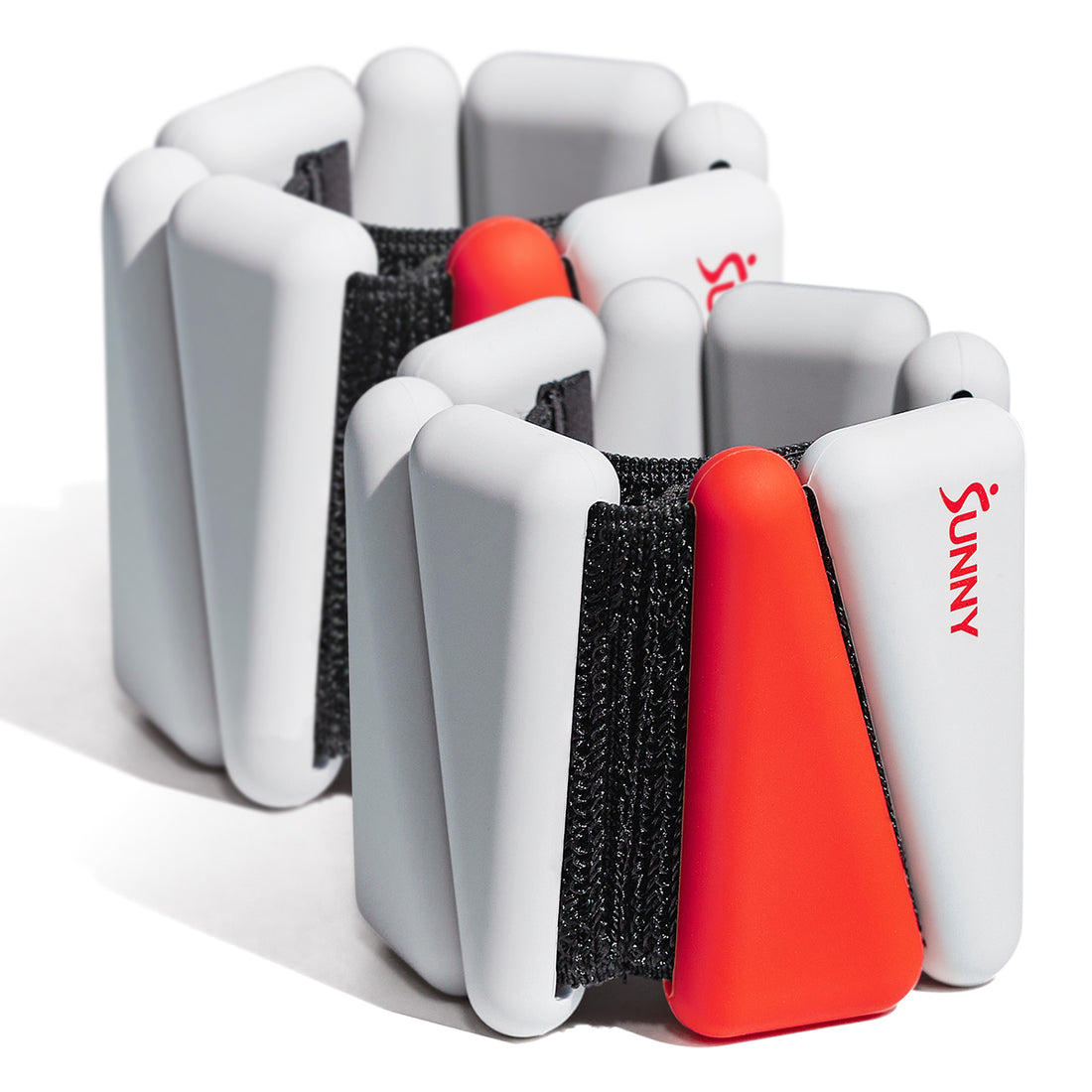
Wrist weights: Small loads worn around the wrists to increase resistance during upper-body or full-body movements.
-
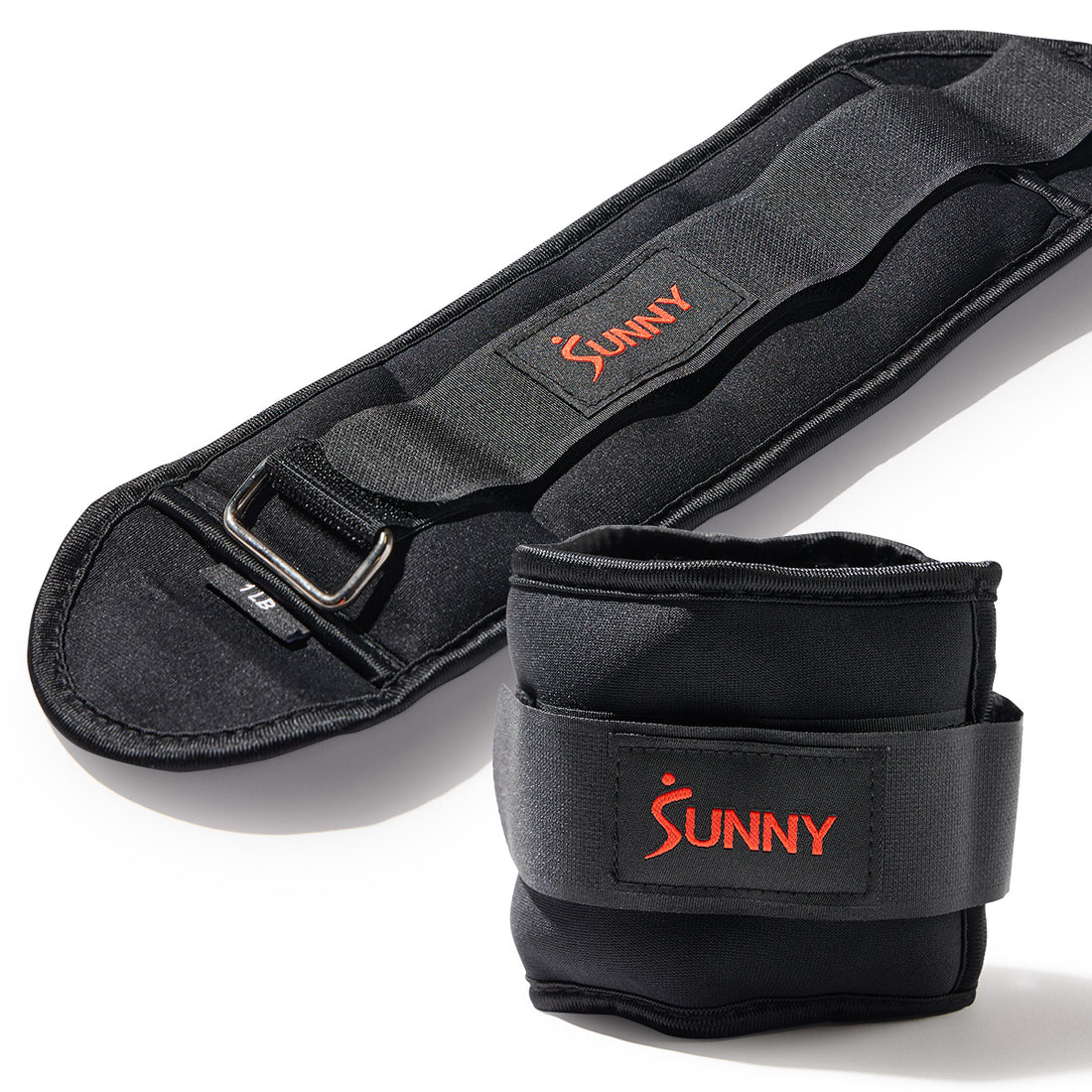
Ankle weights: Resistance worn around the ankles to increase the demand on the legs and hips.
Sunny Health & Fitness offers all three, including adjustable weighted vests, 1- and 2-pound wrist-weight options, and ankle weights ranging from 1 to 5 pounds per side.
The key difference between these tools is where the resistance is placed. That changes how your body must produce and control force.
Think of wearable weights as a way to put “more volume” on a movement. You aren't necessarily trying to turn it all the way up. You're trying to find the right setting.
Weighted Vests: Add Resistance to the Whole Body
A weighted vest places resistance close to your body's center of mass, making it particularly useful for movements such as:
- Walking
- Step-ups
- Squats
- Lunges
-
Push-ups
- Bodyweight rows
- Calf raises
- Hiking
- Stair climbing
Because the load is distributed around the torso, a vest can increase the resistance of lower-body and full-body movements without requiring you to hold something in your hands.
Research has shown that weighted-vest walking increases oxygen consumption and relative exercise intensity compared with unloaded walking.
That means a simple walk can become a more demanding training session without changing your route.
Weighted vests can also be useful for people who want to progressively challenge functional movements. In one study involving older women, a progressive exercise program using weighted vests improved lower-body strength, muscular power, and measures of postural stability.
Some safety considerations for weighted vests: Is not recommended for users with back or neck issues and best not to use for long-duration or high-impact use. Additionally, make sure to start with a vest that is 5% of your body weight.
Beginner-friendly weighted-vest exercises
Start with movements you already perform well:
Bodyweight squat
Add a light vest and perform 2–3 sets of 8–12 repetitions.
Step-up
Use a low step and focus on controlled movement through the entire range of motion.
Walking
Start with a short, comfortable walk before increasing either the load or duration.
Incline push-up
The vest can increase resistance while the hands remain free.
Reverse lunge
Keep the load light and prioritize balance and control.
The goal is not to turn your first weighted-vest workout into a survival documentary. Start conservatively and allow your body to adapt.

Wrist Weights: Small Load, Big Difference
Wrist weights are especially useful when you want to add resistance to movements involving the arms without gripping a dumbbell.
Try them with:
- Standing lateral raises
- Punches
- Pilates
- Barre
- Mobility exercises
- Arm raises
- Shadow boxing
- Low-impact aerobic movements
Because the resistance is positioned farther away from the shoulder joint than a vest, even a relatively small amount of weight can change the demands of arm movements.
That is why lighter is usually better with wrist weights.
Sunny's adjustable wrist weights allow the resistance to be fine-tuned in small increments, making them useful for gradually increasing the challenge rather than making a giant jump in load.
Try this beginner circuit
Perform 30–45 seconds of each:
- March in place with alternating arm swings
- Standing lateral raises
- Front raises
- Punches
- Step-touch with arm reaches
Rest for 30–60 seconds and repeat for 2–3 rounds.
The workout doesn't need to be complicated. The resistance simply changes the stimulus.
Ankle Weights: Target the Hips and Legs
Ankle weights are particularly useful for controlled lower-body movements where you want to challenge the muscles responsible for hip and knee movement.
Try them with:
- Straight-leg raises
- Hip abduction
- Hip extension
- Glute kickbacks
- Controlled leg lifts
- Standing marches
- Side leg raises
They can be particularly useful when the goal is controlled strength rather than maximum load.
Sunny's ankle weights are available in 1-, 2-, 3-, 4-, and 5-pound options per side, allowing resistance to be progressed gradually.
For beginners, rehabilitation settings, or someone returning to exercise, that gradual loading can be valuable.
Recent research has also investigated ankle-weighted Nordic walking in older adults, with findings supporting the potential for wearable ankle resistance to contribute to improvements in muscular strength outcomes.
Important distinction
Ankle weights aren't simply miniature dumbbells for your legs.
Because the load sits farther from the hip, it can substantially change the mechanics of a movement. That makes them excellent for some controlled exercises, but not automatically appropriate for every activity.
Use them intentionally rather than treating them as an accessory you leave on for everything.
What About Advanced Lifters?
This is where wearable weights get especially interesting.
If you are already comfortable with barbells, dumbbells, machines, and traditional resistance training, you might wonder:
Why would I bother with a 1- or 2-pound wearable weight when I can squat hundreds of pounds?
Because heavier isn't always more useful.
A maximal or near-maximal lift tells you a lot about your ability to produce force, but it doesn't always tell you where your movement breaks down.
An athlete may be incredibly strong in a squat but struggle with:
- Single-leg stability
- Hip control
- Shoulder positioning
-
Balance
- End-range strength
- Deceleration
- Maintaining posture under fatigue
- Controlling a limb independently
Wearable resistance can provide a way to isolate and train some of those qualities.
Find the weakness hiding inside the strength
Imagine an experienced lifter performing a single-leg squat.
With bodyweight alone, the movement looks controlled.
Add a small ankle weight and suddenly the athlete's knee begins drifting, the pelvis rotates, or balance disappears.
That tiny amount of additional resistance didn't make the athlete “weak.”
It revealed a movement demand that needed attention.
This is one of the most valuable applications of wearable weights: using a small external load to challenge control rather than simply chasing heavier numbers.
Wearable Resistance and Sports Performance
Wearable resistance can also be used for sport-specific training.
Athletes can use carefully selected loads during movements that resemble their sport, including:
- Running drills
- Acceleration work
- Defensive slides
- Jumping patterns
- Change-of-direction drills
- Throwing patterns
- Movement preparation
- Sport-specific conditioning
Research on wearable resistance has found that strategically placed loads can alter movement mechanics and increase the demand of sport-specific movements. A systematic review found that lower-limb wearable resistance can selectively overload aspects of sprint mechanics, although the appropriate load and application depend on the athlete and objective.
More recent research is promising but also provides an important reality check: wearable resistance may improve certain performance qualities, but the evidence is not strong enough to suggest that simply wearing weights automatically makes an athlete faster or more powerful.
In other words:
The tool isn't the training program.
How you use it matters.
Wearable Weights for Recovery and Rehabilitation
Another potential application is rehabilitation and rebuilding strength after injury or periods of reduced activity.
Physical therapists and qualified rehabilitation professionals may use light external resistance to progressively challenge specific movements while maintaining control over range of motion and technique.
For example, a person rebuilding lower-body strength might perform controlled:
- Leg raises
- Hip abduction
- Hip extension
- Sit-to-stand movements
- Step-ups
A small amount of resistance can increase the muscular demand without requiring a heavy dumbbell or barbell.
For someone returning from injury, however, the correct load and exercise selection should come from a physical therapist or other qualified healthcare professional. Pain, injury history, surgical restrictions, and movement limitations all matter.
Wearable weights can be a tool in rehabilitation. They should not replace individualized rehabilitation guidance.
How Much Weight Should You Use?
This is where the phrase “start light” earns its paycheck.
The appropriate load depends on your exercise, training history, body size, movement quality, and goal.
A useful progression is:
| Step 1 | Master the movement without added resistance |
| Step 2 | Add the smallest practical load |
| Step 3 | Maintain good technique |
| Step 4 | Increase repetitions, duration, or resistance gradually |
| Step 5 | Only increase the load when the current level feels controlled |
For wearable weights, increasing resistance isn't the only form of progressive overload.
You can also progress by increasing:
- Repetitions
- Sets
- Time under tension
- Range of motion
- Movement complexity
- Training frequency
- Walking distance
- Walking speed
This gives you multiple knobs to turn instead of constantly reaching for heavier weights.
A Simple Rule for Beginners
If adding the weight causes you to change the movement, the weight is too heavy for that exercise.
You shouldn't have to swing your legs, shrug your shoulders, lose your balance, shorten your range of motion, or dramatically change your walking pattern just to complete the repetition.
The resistance should challenge the movement without hijacking it.
Wearable Weights Are Made for Real Life
One of their biggest advantages has nothing to do with biomechanics.
They are convenient.
A dumbbell can become an obstacle when you're traveling. A barbell is not exactly a carry-on item. A fully equipped gym is wonderful until you're staying in a hotel room with approximately 14 square feet of floor space.
Wearable weights are different.
They can fit into a home workout, office movement break, hotel-room session, outdoor walk, or vacation workout.
Sunny's adjustable wrist and ankle weights even come with a storage pouch designed for convenient travel.
That portability makes them particularly useful for people who struggle with the classic barrier:
“I don't have time to work out.”
You may not have an hour.
But you might have 10 minutes.
Ten minutes of squats, lunges, marching, controlled leg raises, and upper-body movements can still become meaningful physical activity.
A 10-Minute Anywhere Wearable-Weight Workout
Try this simple circuit at home, in a hotel room, or outdoors.
Perform 40 seconds of work followed by 20 seconds of rest. Complete 2 rounds.
- Squats
- Reverse lunges
- Marching with arm drives
- Standing lateral leg raises
- Incline push-ups
- Glute kickbacks
- Step-ups or alternating knee drives
- Standing punches
- Calf raises
- Bodyweight good mornings
Choose your wearable weight based on the movement.
You don't necessarily need the same resistance for every exercise.
That is one of the advantages of having multiple wearable-weight options.

The Bottom Line: Small Weights, Strategic Training
Wearable weights aren't designed to replace barbells, dumbbells, machines, or other forms of resistance training.
They give you another tool.
For beginners, they can make simple movements more challenging and help create accessible workouts almost anywhere.
For experienced exercisers, they can provide a different form of resistance that challenges balance, coordination, stabilization, and movement-specific strength.
For athletes, they can be incorporated into carefully designed sport-specific training.
And for rehabilitation, light wearable resistance may provide a practical way to progressively load controlled movements under professional guidance.


Add Your Name & Email
Please enter your name and email to continue.We won’t display your email publicly.