




Claire Jenkins
Fitness Trainer
ACSM-CEP, MS, RYT-200
Over the last decade, Pilates has had a remarkable resurgence in popularity, capturing the attention of everyone from elite athletes, physical therapists to celebrities and beginners looking for a low-impact, full-body workout. But behind the aesthetic videos is a training method supported by decades of research demonstrating benefits for strength, flexibility, balance, posture, and overall physical function. [1–4]
Reformer Pilates offers a unique combination of resistance training, mobility work, and mindful movement. The adjustable springs provide progressive resistance while reducing stress on the joints, making it suitable for a wide variety of fitness levels and ages.[5]
If you're curious about what reformer Pilates actually is, and how it differs from traditional mat Pilates, this guide breaks down the science behind the method and helps you determine which style best aligns with your goals.
What Is Reformer Pilates?
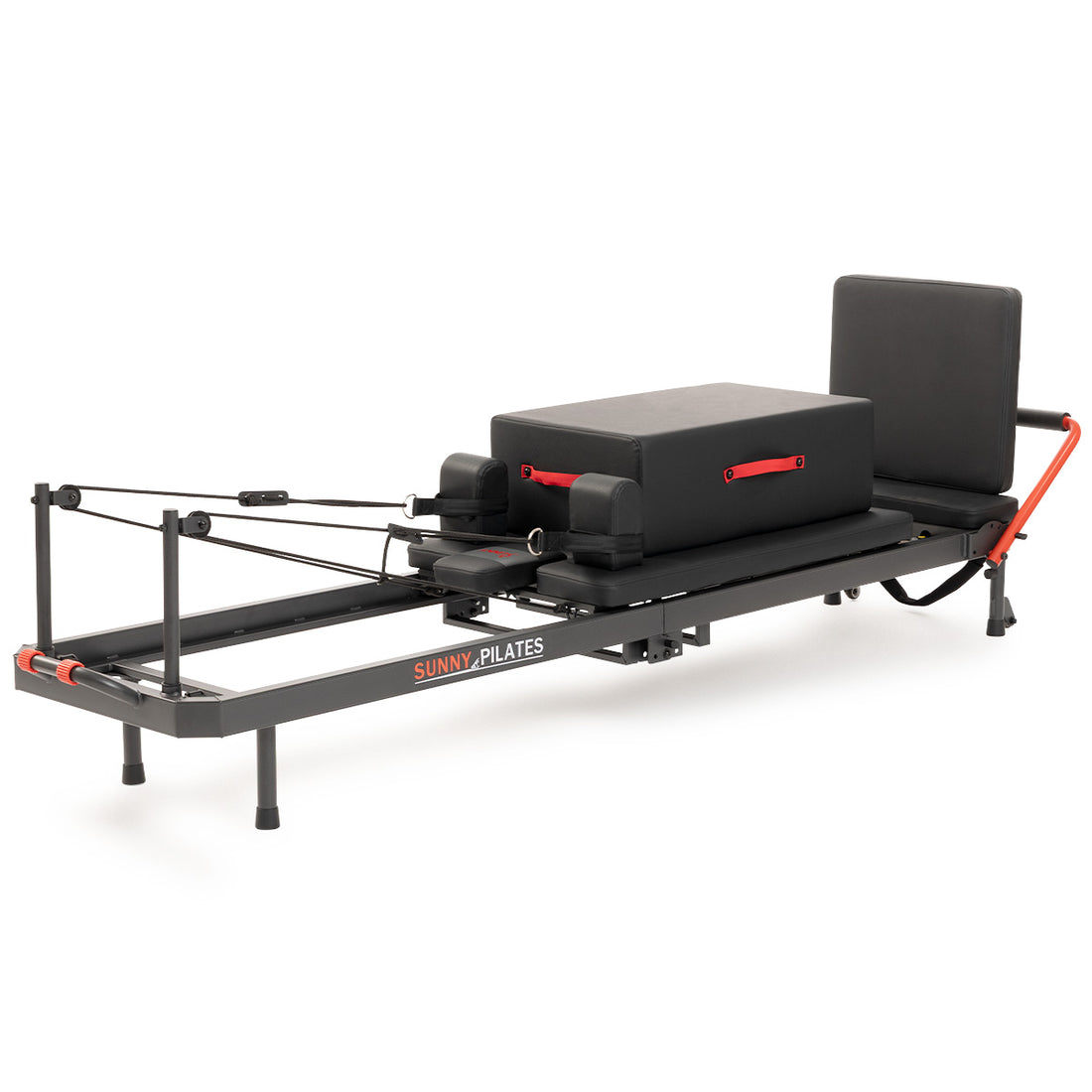
Invented by Joseph Pilates during World War 1, reformer Pilates is a workout performed on a specialized piece of equipment called a reformer. Unlike mat Pilates, which relies primarily on body weight for resistance, the reformer uses adjustable springs, straps, pulleys, and a moving carriage to create resistance and support throughout each exercise.
Although reformers may initially appear intimidating, they're designed to accommodate both beginners and advanced exercisers. The machine's adjustable resistance allows users to make exercises easier or more challenging depending on their strength, mobility, and experience.
A typical reformer consists of several key components:
- Sliding carriage: A padded platform that moves back and forth along rails.
- Resistance springs: Springs of varying tension provide adjustable resistance.
- Footbar: Used for pushing movements involving the legs and feet.
- Shoulder blocks: Help stabilize the body during many exercises.
- Ropes and straps: Allow upper- and lower-body exercises from multiple angles.
- Headrest: Supports proper cervical alignment during supine exercises.
Together, these components allow for hundreds of exercises targeting nearly every major muscle group.
How Does a Reformer Work?
One of the defining features of reformer Pilates is its spring-based resistance system.
Unlike free weights, where gravity provides constant downward resistance, reformer springs create variable resistance throughout an exercise's range of motion. Depending on the movement and spring configuration, the resistance can either assist or challenge the body.
For example:
- During leg presses, the springs resist the carriage as you push away from the footbar.
- During arm exercises, the straps create resistance that challenges the shoulders, chest, and upper back.
- Certain movements use lighter spring settings to improve stability and motor control rather than maximize force production.
This versatility makes reformer Pilates particularly valuable for individuals who want to build strength while minimizing excessive joint loading. [2,5]
Because the carriage moves, many exercises also require continuous stabilization from the core, hips, shoulders, and spine. Rather than isolating a single muscle, reformer exercises often recruit multiple muscle groups simultaneously, promoting coordinated movement patterns and whole-body control.[3]
The Six Principles of Pilates
Whether performed on a mat or a reformer, Pilates is built upon several foundational principles that guide every movement. Although different Pilates schools may describe them slightly differently, the traditional principles include:
1. Concentration
Pilates emphasizes mindful movement rather than simply completing repetitions. Paying attention to body position and movement quality helps reinforce proper movement patterns.
2. Control
Joseph Pilates originally referred to his exercise method as Contrology, highlighting the importance of deliberate, controlled movement instead of relying on momentum.
3. Centering
Often called the "powerhouse," the center includes the deep abdominal muscles, pelvic floor, diaphragm, lower back, and hip muscles. Many Pilates exercises begin by establishing stability through this region.
4. Precision
Pilates prioritizes movement quality over quantity. Small adjustments in alignment can significantly affect which muscles are activated.
5. Breath
Controlled breathing helps coordinate movement, improve trunk stability, and encourage efficient muscle activation.[6]
6. Flow
Exercises are designed to transition smoothly from one movement to the next, promoting coordination and efficient movement patterns.
These principles distinguish Pilates from many traditional strength-training programs by emphasizing movement efficiency in addition to muscular fitness.
Why Is Everyone Talking About Reformer Pilates?
The recent explosion in reformer Pilates isn't simply the result of celebrity endorsements or social media trends. Several factors have contributed to its growing popularity.
1. It Provides Low-Impact Strength Training
Many people want the benefits of resistance training without placing excessive stress on their joints. Because the reformer's springs reduce impact while still providing meaningful resistance, workouts can strengthen muscles with less compressive force than high-impact activities such as running or jumping.[5]
2. It Challenges More Than Just the Core
Pilates is often associated with abdominal exercises, but modern reformer workouts are truly full-body training sessions. Many movements integrate several muscle groups simultaneously, improving coordination and functional strength rather than isolating individual muscles. Research suggests Pilates training can improve muscular endurance, balance, flexibility, and movement efficiency across multiple populations. [1–4]
3. It's Supported by Scientific Research
Unlike many fitness fads, Pilates has been the subject of hundreds of scientific studies over the past two decades. Systematic reviews have found Pilates programs may improve:
- Core muscular endurance [1]
- Dynamic balance [2]
- Flexibility [3]
- Functional movement [4]
- Chronic low back pain symptoms [7]
- Physical function in older adults [8]
While research continues to evolve, the growing body of evidence supports Pilates as an effective form of exercise for both healthy individuals and certain clinical populations.
Importantly, benefits depend on factors such as program quality, consistency, instructor guidance, and individual health status.
4. It Appeals to a Wide Range of Fitness Levels
One of the biggest misconceptions about reformer Pilates is that it's only for dancers or highly flexible individuals. In reality, the adjustable springs allow exercises to be modified for nearly every ability level. A beginner may perform an exercise using lighter resistance and a smaller range of motion, while an experienced practitioner can increase spring tension or perform more advanced movement variations.
5. Home Reformers Have Become More Accessible
Historically, reformer Pilates was largely confined to boutique studios because the equipment was bulky, expensive, and difficult to fit into a home. Today's home reformers are changing that.
Many modern models are designed with features that make them practical for home use, including:
- Foldable frames for easier storage
- Smooth-gliding carriages
- Adjustable spring systems
- Transport wheels
- Compact footprints
These innovations make it possible to experience studio-style reformer workouts without the recurring cost of studio memberships or the need to commute to classes.
6. It's Highly Versatile
Another reason reformer Pilates continues to gain popularity is the sheer variety of exercises it allows. A single reformer can be used for:
- Strength training
- Mobility work
- Core conditioning
- Balance exercises
- Flexibility training
- Athletic conditioning
- Low-impact cardio intervals using a jump board
- Rehabilitation under professional supervision
Because resistance can be adjusted in seconds, workouts can easily shift from gentle mobility sessions to challenging full-body strength routines.
Reformer Pilates vs. Mat Pilates: Which Is Better?
While reformer Pilates has gained significant attention in recent years, mat Pilates remains one of the most accessible and effective ways to practice the Pilates method. Both styles are rooted in the same principles developed by Joseph Pilates, emphasizing controlled movement, proper breathing, core stability, and mindful exercise. However, the equipment used (and the training experience it creates) differs substantially.
So, when it comes to reformer vs. mat Pilates, is one actually better than the other?
The answer depends on your fitness level, goals, budget, and personal preferences. Both forms can improve strength, flexibility, posture, balance, and body awareness, but they do so in slightly different ways.
Which Builds More Strength?
Strength gains depend on several factors, including exercise intensity, resistance, training frequency, and progression.
Because reformer Pilates allows resistance to be adjusted through spring combinations, it generally offers greater opportunities for progressive strength development than mat Pilates alone.
Examples include:
- Increasing spring tension over time
- Performing single-leg variations
- Adding instability challenges
- Increasing range of motion
- Incorporating jump board exercises
Mat Pilates certainly builds muscular endurance and body control, but adding significant external resistance is more limited unless additional equipment is introduced. For individuals whose goals include developing greater whole-body strength while maintaining low-impact exercise, reformer Pilates may offer more training flexibility. In either case, small accessories like a Pilates ball or ring, can expand exercise options and offer a nice complement to the benefits each style provides.

Which Is Better for Beginners?
Many people assume mat Pilates is easier because it requires less equipment. Surprisingly, that isn't always true. Some foundational mat exercises require substantial abdominal strength and body awareness, making them difficult for beginners to perform with proper technique.
A reformer, on the other hand, can make certain exercises more approachable because the springs provide assistance during movements such as:
- Footwork
- Assisted squats
- Supported bridges
- Leg circles
- Seated rowing
- Standing balance exercises
The adjustable resistance allows instructors or users at home to tailor exercises to current ability levels. This is one reason reformer Pilates is commonly used in rehabilitation settings under professional supervision.[3]
Which Burns More Calories?
Calorie expenditure varies depending on workout intensity, exercise selection, body size, and fitness level.
Currently, there is limited research directly comparing calorie burn between reformer and mat Pilates. In general:
- Gentle mat Pilates may burn fewer calories than a vigorous reformer session.
- High-intensity mat Pilates may burn similar amounts to moderate reformer workouts.
- Incorporating a jump board on a reformer can increase cardiovascular demand while maintaining relatively low joint impact.
Rather than focusing solely on calorie burn, many experts recommend choosing the exercise style that you enjoy enough to perform consistently, as long-term adherence is one of the strongest predictors of health benefits.[9]
Balance and Stability
Balance naturally declines with age, making it an important component of long-term health. Several systematic reviews have found that Pilates training can improve both static and dynamic balance in healthy adults and older adults. [4,8] The reformer introduces additional balance challenges because users must control a moving carriage while maintaining proper alignment. Meanwhile, mat Pilates often emphasizes controlling body position without external support. Both styles can contribute to improved balance, though the mechanisms differ slightly.
Flexibility and Mobility
One of Pilates' defining characteristics is its emphasis on moving joints through controlled ranges of motion. Research consistently demonstrates improvements in flexibility following regular Pilates participation. [1,6] Reformer Pilates offers some unique advantages:
- Springs can assist deeper stretches.
- The carriage allows smooth movement through larger ranges of motion.
- Adjustable resistance enables gradual progression.
Mat Pilates also improves flexibility through controlled movement patterns and active stretching, making either option beneficial for maintaining mobility.
Rehabilitation and Injury Recovery
Pilates has become increasingly common within physical therapy and rehabilitation settings. Research supports Pilates-based exercise for improving pain and function in individuals with chronic nonspecific low back pain. [7] Because reformers allow resistance to be precisely adjusted, clinicians often use them to:
- Restore movement after injury
- Improve neuromuscular control
- Build strength gradually
- Reduce excessive joint loading
It's important to note that individuals recovering from injury should always follow guidance from qualified healthcare professionals before beginning a new exercise program.
Which One Is Better for Your Goals?
Ultimately, the choice between reformer vs. mat Pilates depends on what you hope to achieve from the workout.
Choose Reformer Pilates if you want to:
- Build strength using adjustable resistance
- Progress strength over time
- Increase exercise variety
- Enjoy studio-style workouts at home
- Perform low-impact resistance training
- Add cardio intervals with a jump board
- Experience greater exercise versatility
Choose Mat Pilates if you want to:
- Start with minimal equipment
- Exercise while traveling
- Follow online classes anywhere
- Improve body awareness
- Build core endurance
- Spend less on equipment
For many people, the two methods complement one another rather than compete. Practicing mat Pilates can reinforce movement fundamentals, while reformer Pilates introduces additional resistance, variety, and progression.
Final Thoughts
Reformer Pilates has earned its growing popularity for good reason. By combining strength training, mobility, balance, flexibility, and mindful movement into a single low-impact workout, it offers a well-rounded approach to fitness that can be adapted for a wide range of ages, experience levels, and goals.
While mat Pilates remains an excellent option for improving core strength and body awareness with minimal equipment, reformer Pilates expands on those foundations by introducing adjustable resistance, greater exercise variety, and nearly endless opportunities for progression.
Ultimately, the best Pilates program is the one you'll enjoy and return to consistently. By choosing the format that fits your lifestyle and goals, you can build a routine that supports long-term strength, mobility, and overall well-being.


Add Your Name & Email
Please enter your name and email to continue.We won’t display your email publicly.